Thursday, 15 November 2012

Planning cinematography

Planning cinematography

The cinematography of a scene is the camera shots which are used to create the film. The director uses different shots in order to create a story which can be watched and understood by the audience. 
Different camera shots can be used to connote and denote things to the audience about the film, and the hidden meanings behind the characters actions.

When creating a thriller film, camera shots are a useful device to create tension and a sinister atmosphere.
Close up shots clearly convey the feelings of the character to the audience, highlighting their intense fear or maybe happiness, before they know that anything is wrong.
A low angle shot can be used to convey the power of a certain character within a scene, as they appear dominant and threatening, in comparison to the weak and vulnerable victim, who may be filmed with a high angle shot.

In our group thriller film, we decided to include an over the shoulder shot from the point of view of the attacker, in order to highlight to the audience how close they were in relation to the victim, standing only meters behind her. This will create a sense of sinister foreboding for the audience as they know that her fate is inevitable now he is slow close to her and she remains unaware of his presence.
It isn't conventional to show the scene from the point of view of an attacker, however by using this type of shot, the face of the attacker will remain a mystery as you will only be able to see the side, or back, of his head. This effectively creates an enigma within the opening scene, an element which is conventional to thriller films.

We also decided to use close up shots of the face of the victim. This will enable us to clearly convey her feelings to the audience, allowing them to empathise with her.
When she finally sees the face of the attacker we plan to use a close up shot which will display the fear that is radiating through her as she sets her sights on the mystery male.
The use of a close up shot is a common convention of thriller films, as directors like to create feelings of empathy for the character, in order to draw the audience's attention into the film completely, compelling them to watch it for the duration, in order to discover the fate of the character they have built these empathetic feelings towards.

A panning shot is another type of camera shot which we plan to include in our film in order to follow the steps of the girls as they walk down the street. This will make the film appear more realistic to the audience, as they feel as though they could be in the scene with the characters too. Realism is a common convention of thriller films, as the director aims to create a situation which scares the audience through the idea that the images taking place on screen, could easily happen to them in real life.

Rather than deciding to use an establishing shot as our first shot, we instead decided on using a long shot which focuses on the group of girls walking home from school. This will act as an establishing shot, as the target audience (who are in the same age range of the girls) will recognise the walk home from school from their own personal experience, and understand straight away the context of the opening sequence.
It is conventional for thriller films to leave out the use of an establishing shot within the first scenes, as it creates a much for enigmatic opening if the audience has no idea when or where these events are taking place.

I believe that our target audience will be able to form a relationship with the characters in our thriller through our choice of camera shots.
The close up shots will clearly convey the feelings of the character, for example her pain or fear, to the audience, enabling them to feel empathy for her and the situation she is in, therefore forming a relationship between the audience and the female protagonist.
The panning shot will enable to the audience to feel as if the film is real, and they too could be there with the characters, and making the scarier scenes appear more sinister.

Monday, 12 November 2012

Opening scene narration

Opening scene narration

The opening sequence of my thriller film will begin with a long shot, clearly showing a group of 4 girls walking home from school. This will act as an establishing shot, as the audience will recognise the familiar walk home from school that they (the target audience) are all familiar with as they are close to the age of the character. 

In order to link this shot to the following over the shoulder shot, I plan to use a straight cut, as the next part of the scene is from the point of view of the attacker. Filmed over his shoulder, the scene will follow on the girls as they walk home talking and laughing, focusing particularly on one of the girls more than the others. The audience will realise that, from this focus, that she may be the reason the mystery man is hiding out of sight.

This shot will be followed by a dissolve, with the way the image fades and breaks away into the new scene representing the unstable and fragmented mind of the attacker, as he watches the girl. 
As the new shot becomes clear, the audience will watch as the girl says good bye to her friends and walks through a metal gate into the field on her own. This will use a mid shot so that enough detail is included in the scene to make it appear realistic. The audience will clearly be able to recognise the youthful innocence and vulnerability of the female protagonist. The shot will feature the use of natural sound, heavy breathing from the male creating a sinister atmosphere as he watches the group of girls. 

The next shot will be introduced via invisible editing, as the female victim walks through the field on her own, earphones in and music blasting so that it is audible to the audience, even though it is muffled. A shallow focus will also be used in this scene, to blur out the background and keep the character in main focus. The audience will however be able to recognise a dark shadow in the background, and therefore make the connection between this figure, moving closer to the female, and the figure who was watching her as she talked with her friends. This will create a sinister atmosphere as well as dramatic irony within this scene, as the audience knows that the outcome for the victim is not looking good, yet she is still in the state of equilibrium (as proposed by Todorov's theory) before she even knows that anything is wrong. 

This shot will then change to the next, again using a dissolve to highlight the unbalanced mind of the mystery attacker. The location of this shot will be different to the previous location of the empty field, with the scene now being set in a darkened room, with a man sitting at a desk, facing away from the camera, cutting up pictures. The audience will recognise the girl in the pictures to be the same girl who is walking home from school, through the field on her own. 
All of the scenes so far will feature natural sound and as will this one, with the sound of female laughter seemingly echoing through the room. 

The scene will then dissolve back into the previous scene, as the female looks over her shoulder, as if she is conscious that someone is there. The shallow focus will be removed, and the audience will clearly be able to see that there is no one there. This adds a sense of ambiguity to the scene as the audience wonders how the man could have disappeared so quickly. As well as the ambiguity this creates, it also makes the male appear more powerful, as the audience has no idea how he could have got out of the shot so quickly, and remain unnoticed. 

Yet another dissolve will follow the mid shot in the previous part of the scene, changing the location back the same darkened room as before. This time however, the male stands up, grabbing a balaclava and baseball bat, dragging this behind him carelessly as he leaves the room. 
This scene foreshadows what is about to happen to the victim, further enhancing the dramatic irony which is present throughout the opening scene. 

This scene will dissolve back into the previous shot, as the female continues to look over her shoulder, before turning back to face the camera. The audience will watch as her expression changes to fear, as a man in dark clothing walks into the scene in front of her, balaclava over his head.

A jump cut will then be used to merge the next scene with this one, and the audience will watch the mid shot as she begins to back away from the attacker, frozen with fear. 

Another jump cut will then feature, as the camera pans downwards and focuses on the baseball bat, swinging in the man's hand, as he holds it loosely at his side. 

Planning the mise en scene

Planning the mise en scene

The mise en scene of a film has five different sections:
  • Setting and iconography
  • Facial expressions and body language
  • Costume, hair and make up
  • Lighting and colour
  • Positioning of characters
All of these different areas form the overall scene that the audience sees on screen, and enables the director to create an effective and successful film. 

The first area, setting and location is one if the most important areas of film making, setting the scene for the audience and helping them to understand the plot of the film. 
For our group thriller film, we decided on the isolated location of an empty field as we felt that it would create an appropriately thrilling location for the events to take place, having a scary effect on the audience. 


*** picture of location ***


The second area of mise en scene is facial expressions and body language. This is a key convention which displays to the audience clearly how the characters are feeling in the different situations. The actor is able to show the audience how scared their character is feeling through worried or horrified facial expressions which have a powerful effect on the audience, as they too experience these feelings as empathy. To clearly convey facial expressions we decided to use close up shots on the face of the victim to highlight her fear at her unfortunate situation. 

Costume, hair and make up is the third area of mise en scene creation. This convention allows the director to connote facts about the individual characters to the audience, enabling them to create expectations as to what will take place within the film.
Our attacker will be dressed in dark colours to connote to the audience the evil that controls his mind, and the dark plans that he is forming regarding the female victim.
The victim, however, will be contrastingly dressed in light school uniform to convey her youthful innocence in comparison to the dark and brooding mind of the attacker.


*** picture of attacker's clothing ***


The fourth area of mise en scene creation is lighting and colour. Using different colours within in a scene can create strong connotations and denotations for the audience to recognise. For example the colour red can be used to represent danger and violence, foreshadowing these elements later on in the film.
Lighting can be used to create shadows and effect the atmosphere within a certain scene, emphasising the effect the scene has on the audience, i.e. a scene shot in low key lighting will appear more sinister and threatening to the audience than a scene shot in bright, high key lighting.
As we are filming our thriller film during the day, as the girls are walking home from school it is difficult to use low key lighting to create a sinister atmosphere. However, as we are filming our thriller in November / December, the lighting will naturally be more low key than if we were filming in the middle of summer.
The audience will recognise the darkening streets as a sign of the early nights that come with winter and anticipate the danger associated with the total darkness that will engulf her as she walks through the empty field.


*** picture from one of the scenes using low key lighting ***


The fifth and last area of mise en scene is the positioning of characters within the frame, in order to convey importance or high status. It can also be used to draw the audience's attention towards certain things.
In our thriller, we plan to use close up shots in order to display the female victim's emotions, but also to highlight her importance to the plot line. Before she is attacked, and is still walking with her friends, a close up shot could be used in order to convey her specific importance, out of all of her friends, within the rest of the plot.


*** example of a close up shot ***


Representation of characters

Representation of characters

It is important to have a variety of different characters within a thriller film in order to create diversity within the story line and allows the audience to understand the narrative. Different characters have different roles within the plot, creating the complicated and entertaining story line for the audience to watch.

The main protagonist in the film is our female victim, Caroline, who appears to be around the age of 16. Her age is connoted through her school uniform, as the audience will recognise she is still of school age. Her age matches that of our target audience, allowing them to easily identify, and empathise with them. 'Caroline' will meet the stereotype of a young, white, female victim, a character type which is commonly found in thriller films, such as the Scream film series.
She will have a normal background, coming from a middle class family and good school education, however a past relationship that went sour has caused a series of events that lead to her demise.
'Caroline' is the main protagonist within the narrative as she is the focus of the scene, and the target of the attacker. The audience is intended to sympathise with her and fear for the situation that she is in.

Our main protagonist will be the target of a violent attack by a mystery killer. Our 'attacker' will have a hidden identity in order to create ambiguity and uncertainty surrounding his motives.
As a rejection of the Caroline's affection, the audience will be unaware of his all consuming obsession with her, or the fact that her rejection motivates his violent plans.
His name, age and motives will be hidden to the audience, creating an instant enigma to draw the attention of the audience, as they wonder what is motivating him to stalk this seemingly innocent victim.

The opening sequence will also feature three extras who will play the part of Caroline's friends. They will be seen walking home with her, talking about their plans for the weekend before she leaves them to take the lonely and isolated shortcut home. The audience will not know much information about these characters as they are not important to the plot line, apart from the way in which their absence endangers Caroline's life. The audience knows that if they had walked with her, then Caroline may have found a way to survive the violent situation that she finds herself in. 

Thursday, 8 November 2012

Production roles

Production roles

When creating a film, there are different roles that individuals need to take on, in order to be organised, and successful in making the film. 
The main roles within film production are camera operator, actors, film director, location manager and storyboard organiser. 

The role of the film director is to direct and manage the actors and film crew when creating the production. They control the dramatic and artistic factors within the production, making important decisions on how the film will be displayed on screen, and how each character will be portrayed. As a group, we decided that Amy will take on this role, as she has a clear vision of how the film should appear as a final product, and how each character should be portrayed to the audience. 

The role of camera operator, usually referred to as a cinematographer, controls the part of the film production involved in actually filming the different shots, ensuring that they are all shot perfectly, or if any changes need to be made making sure that these shots are filmed again. The group decision was that I would take on this role within the film production, as I will ensure that all scenes are shot perfectly in order to create an effectively dramatic, and suspenseful thriller film. 

The actors within the film play the roles of the different characters. Their job is to make the film and events taking place appear as realistic as possible, ensuring that the audience is drawn into the film, believing that these events could actually take place. We decided that George would take on the role of the masked attacker, as he would be able to give a believable performance that would have the audience on the edge of their seats. 

Location manager is a role that requires the individual to find the different locations for the film to be shot in, and ensuring that the environment will be suitable for the setting of the scene, i.e. ensuring that the usually busy Oxford Street in London is deserted for a post apocalyptic zombie film, or a crowded beach for an upbeat chick flick. This was a role that we all took on, as it was decided by all of our group members where we should film. This allowed us to look at all possible locations and select the best one for our film. 

The storyboard organiser is responsible for deciding the order in which the different frames will appear within the film, and making sure that they are in a believable, yet creative or artistic fashion. They will draw out every frame to be included, in the correct order to clearly see the flow of the film, and give a visual presentation of what the final film will look like, and aid the director in making any changes to the way in which the film will be presented. 
The storyboards for our group narrative were created by myself and Amy. This helped us to put all of our ideas down on paper and ensure that each of us had a creative influence over the final product. This helped us to ensure that we had the best, and most dramatic ideas possible. 

As well as the group roles of location manager and storyboard organiser, as a group we decided to take on the role of film editor, as this would further enable us to have maximum positive creative influence over the film. The role of a film editor is to take the raw footage, and put it together in a way which will create the final finished product. An editor is able to add computer generated effects to the raw footage such as a shallow focus, or computer generated images (CGI) of fantasy characters. For our thriller, we will edit the scenes together in an appropriate order, before adding in visual effects such as shallow focus. 

Monday, 5 November 2012

Individual storyboards

Individual storyboards for the group narrative


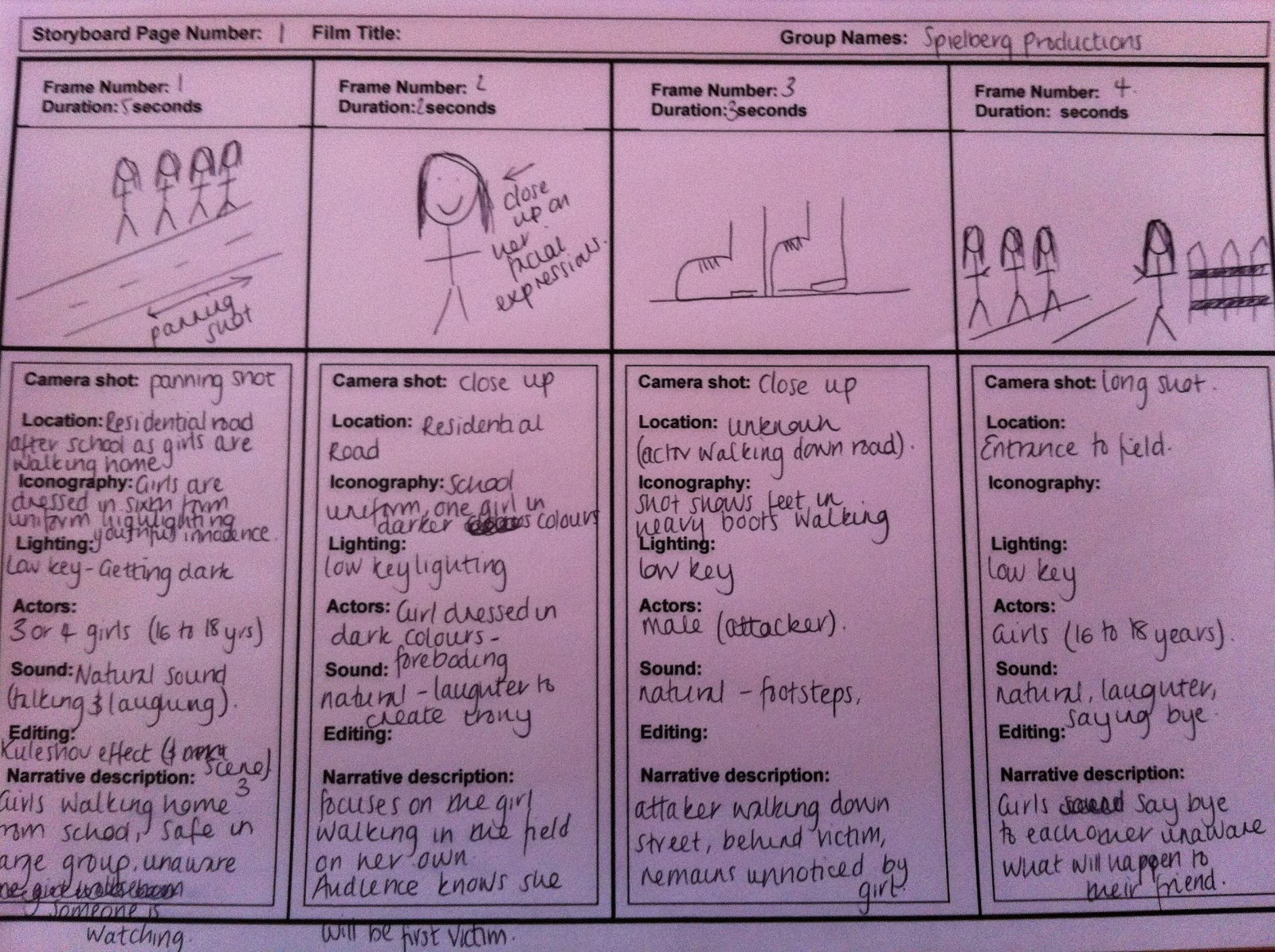
Once we had decided on a group narrative, putting elements of our different ideas together, we individually created storyboards, visually displaying what we believe the final thriller will look like.
My first storyboard displays scenes one to four, idenityfing the way in which I intend to frequently interrupt the images of the young girl walking home, which split second images of the attacker, or clues about his location in comparison to the girl. An examle of this is shown in scene 3, which will focus on the footsteps of the attacker, as he is in quick pursuit of his victim.

The second storyboard which I completed displays the attack scene, and the way that I would like to end the scene, with a close up shot of the baseball bat in the hand of the attacker, foreshadowing future violence rather than showing it.
Through planning out the narrative visually on the storyboard, I was able to see how the scenes would fit together and create an effective final narrative which would build thick tension and suspense for the audience. 


Preliminary task

Preliminary task


As a group, we carried out a preliminary task filming a two minute clip of someone walking into a room, sitting down, and then having a conversation.
Through filming this short clip, we found what difficulties we may face when making our final thrillers, and found ways to make the filming a sucess.
We were able to learn how to film withe certain camera shots, which shots were most effective and appropriate to use within the scene, and we were also able to identify how best to frame the scene, cutting out anything unimportant from the images.
A difficulty which we identified was the barrier of background noise, as members of staff repeatedly walked past the hall as we were filming, muffling the noise that the audience was intended to hear, the conversation between the two characters. We learnt that filming is a drawn out process and it is necessary to re shoot the scenes in which background noise takes over, and blocks out speech.
We also learnt that in order to film a steady shot, a tripod is necessary. When filming with a hand held camera the shot will appear shaky and unprofessional, taking away from suspense that we aim to create in our final thriller film.
While shooting the different parts of the scene, we also found that it is vital to watch the individual shots through once they have been filmed, to ensure that they are the best quality and are appropriate to include in our final sequence.
Appropriate locations are also a key part of the scene, we found. For the sequence to appear realistic the actions and speech taking place must fit the location, and make sense to the audience. For example the converation we filmed for this task was between two students, and in order to match their identity, we filmed the scene in the school hall, as if they had met up for a chat before lessons. If we had filmed this casual conversation in the middle of a field it wouldn't have made sense as a realistic scene to the audience.

While filming the scene, we got to grips with the complicated equipment, learning gradually how to use it. This means that when we come to film our thriller we will not have to waste any time in figuring out how to use the camera and tripod, we will simply be able to spend all of our time filming, focusing on creating the most effective opening sequence that we can.

The lessons that we have learnt in filming the preliminary task will aid us as a group when we are filming our final thriller film. We will know which camera shots are most appropriate, which location is appropriate to the narrative, and to look for ways to combat the barrier of background noise, in order to create the most professional and effective thriller film that we can.
Any of the basic mistakes that we came across will be amended and changed before filming our thriller, and we will also have a better understanding of the way the equipment works.